Former Southern University professor tied to Nobel Prize-winning discovery
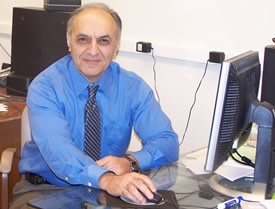
Southern University and A&M College professor emeritus Ali R. Fazely, Ph.D. has contributed to research connected to the IceCube Neutrino Observatory, the groundbreaking scientific project at the center of the 2026 Nobel Prize in Physics.
Fazely collaborated with Francis Halzen, Ph.D., a University of Wisconsin–Madison physicist who received the 2026 Nobel Prize in Physics from the Royal Swedish Academy of Sciences for his decisive contributions to the IceCube Neutrino Observatory and the discovery of high-energy neutrinos of astrophysical origin. The American Institute of Physics announced the recognition Oct. 6.
Located at the South Pole, the IceCube Neutrino Observatory uses more than 5,000 optical sensors embedded in approximately one cubic kilometer of Antarctic ice to detect faint flashes of light produced when neutrinos interact with matter. These nearly massless particles can travel vast distances through the universe, carrying information about some of its most energetic events. The discovery of high-energy neutrinos from astrophysical sources gave scientists a new way to study distant cosmic events beyond traditional observations using light.
Fazely has led Southern’s IceCube-related research activities since 1997, working with graduate students, post-doctoral researchers and scientific collaborators. His team’s work has focused on detector simulations, rare particle decays, supernova neutrinos and high-energy neutrino interaction cross sections.
Fazely said Southern’s participation in the international collaboration highlights the role historically Black colleges and universities can play in advancing scientific research.
“Southern University's participation demonstrates that HBCUs can be active contributors to these efforts, not simply observers of discoveries made elsewhere,” said Fazely.
Southern’s research has helped support the scientific work behind the observatory through computer simulations that model how neutrinos interact with matter, how charged particles travel through ice and how light reaches the detector’s optical sensors. These models help researchers interpret the signals IceCube records, reconstruct neutrino energies and directions, and assess potential improvements to the detector.
The university’s research group has developed simulations for the existing IceCube detector, the IceCube Upgrade and the proposed IceCube-Gen2 observatory. Recent efforts have focused on supernova-neutrino simulations and future detector configurations that could help scientists identify astrophysical signals and investigate physical processes that have not yet been observed.
Fazely’s research also includes studies of rare particle decays and high-energy neutrino interactions. A study exploring the possibility of observing the rare decay of an eta particle into a neutrino-antineutrino pair was published in Physical Review D in 2010. In 2019, the team published research in Journal of Physics G: Nuclear and Particle Physics introducing a Prime-Index parametrization of neutrino-nucleon and proton-proton cross sections.
The research program has also created opportunities for Southern students to participate in advanced scientific investigations. Fazely said two students, Cheng Guo and Aaron Richard, completed Master of Science degrees through IceCube-related research, while graduate student Justin Mitchell is currently involved in the program.
Through their involvement, students gain experience in particle physics, astrophysics, computer programming, statistical analysis and large-scale scientific simulations. They also become familiar with the research methods and scientific standards used in major international collaborations, preparing them for doctoral studies, research careers, national laboratories and technology-related professions.
For Fazely, the program’s impact extends beyond scientific findings to the development of future researchers.
“I am particularly proud that our program has combined scientific research with the education and mentoring of young scientists," he said. "In my view, that is one of Southern University's most important contributions to the future of physics.”